25 Small Kitchen Storage Ideas That Make Every Inch Work Smarter
Let’s be honest—small kitchens have a special talent for humbling us. One minute you’re feeling like a competent adult, the next you’re playing Jenga with pots, lids, and that one rogue Tupperware lid that never has a matching bottom.
Trust me, I’ve been there, standing in my kitchen wondering how a space this small can feel this chaotic. Ever noticed how storage advice always assumes you have endless cabinets? Yeah… same.
So let’s talk real-life, actually-works, small kitchen storage ideas—no fancy nonsense, just smart fixes that make every inch pull its weight.
1. Install Pull-Out Cabinet Shelves
If you’re still kneeling on the floor digging through dark cabinets, I feel you. Pull-out shelves are honestly life-changing because they bring everything to you instead of forcing you to crawl inside like a lost explorer.
Ever wondered why you own three spatulas you forgot about? This is why. I’ve done this way too many times, and pull-outs fixed it almost immediately.
2. Use the Inside of Cabinet Doors
This space is criminally underused, IMO. Adding hooks or slim racks inside cabinet doors gives you instant storage for lids, cutting boards, or measuring cups.
It feels like discovering a secret room in your own house, honestly. Plus, it keeps those awkward items from falling on your toes—small win, big mood boost.
3. Stackable Clear Containers Are Non-Negotiable
Clear containers aren’t just for aesthetic pantry photos, FYI—they’re practical. When you can actually see what you own, you stop buying your fifth bag of rice like it’s a personality trait.
I used to play “guess what’s in this box” weekly, and it never ended well. Stackable ones turn chaos into calm, and tbh, it’s deeply satisfying.
4. Hang a Pegboard Wall
Pegboards are like the Swiss Army knife of small kitchen storage. You can hang utensils, pans, mugs—basically whatever fits and makes sense for how you cook.
Ever noticed how pros always have tools within arm’s reach? That’s the vibe here. It also frees up drawer space, which is pure gold in a tiny kitchen.
5. Use Vertical Space Like You Mean It
If your cabinets don’t reach the ceiling, that’s unused real estate just sitting there. Adding shelves or baskets up high gives you a home for things you don’t use daily.
I stash seasonal appliances there because, honestly, my blender doesn’t need a front-row seat. Vertical storage is the quiet hero no one talks about enough.
6. Add Drawer Dividers Everywhere
Drawers without dividers are just chaos in wood form. I’ve lost entire utensils in there—never to be seen again.
Dividers keep everything visible and stop that annoying clatter every time you open a drawer. Once you try this, going back feels emotionally wrong.
7. Use a Rolling Cart for Extra Storage
Rolling carts are perfect if your kitchen is short on cabinets but long on ambition. You can use one for pantry items, coffee supplies, or even cookware.
The best part? You can move it wherever you need it, like a loyal little storage assistant. I thought it’d be temporary—spoiler: it wasn’t.
8. Store Lids Vertically
Pot lids are the worst. They never stack properly and somehow take up half the cabinet. Storing them vertically with a rack keeps them visible and easy to grab.
Ever wondered why cooking feels stressful before you even start? This is one of those sneaky reasons.
9. Install Under-Shelf Baskets
These little baskets slide under existing shelves and instantly double your storage. It feels like cheating the system, honestly.
I use mine for snacks and wraps, and it’s made everything easier to access. Small change, surprisingly big payoff.
10. Hang Pots and Pans
If cabinet space is tight, hanging pots is a game-changer. Wall-mounted racks or ceiling hooks free up massive amounts of space.
Plus, it makes your kitchen feel intentional instead of cramped. I was skeptical at first, but now I’m fully converted.
11. Use Lazy Susans in Cabinets
Lazy Susans aren’t just for condiments at awkward family dinners. They’re amazing for corner cabinets or deep shelves where items go to disappear.
One spin and boom—everything’s visible. I didn’t realize how much time I wasted digging until I stopped having to.
12. Store Baking Sheets Vertically
Baking sheets stacked horizontally are a nightmare. Storing them vertically keeps things neat and stops the avalanche every time you grab one.
It’s one of those small tweaks that instantly reduces daily irritation. And honestly, fewer loud crashes equals a better day.
13. Add a Magnetic Knife Strip
Knife blocks eat up counter space like it’s their job. A magnetic strip on the wall keeps knives accessible and frees up precious surface area.
It also makes cooking feel more professional, which I fully enjoy pretending I am. Safety tip: install it properly—learned that the hard way.
14. Use Tension Rods Creatively
Tension rods are wildly underrated. You can use them under sinks to hang spray bottles or inside cabinets to separate items.
They’re cheap, adjustable, and weirdly satisfying to install. Ever noticed how the simplest solutions feel the smartest?
15. Store Appliances Based on Frequency
Not everything deserves prime real estate. If you use something daily, keep it accessible; if not, it goes higher or deeper.
I used to rearrange everything constantly until I accepted this truth. Life got easier immediately.
16. Use Open Shelving Strategically
Open shelves aren’t just decorative—they’re functional if done right. Use them for dishes or items you grab daily.
It forces you to keep things tidy, which is both annoying and effective. I complain about it, but it works.
17. Add Hooks Under Cabinets
The underside of cabinets is prime hook territory. Hang mugs, utensils, or even small pans there.
It keeps items within reach and frees up drawer space. Honestly, once you start adding hooks, it’s hard to stop.
18. Use Slim Storage for Tight Gaps
That tiny gap next to your fridge? It’s begging for slim storage. Pull-out racks fit perfectly and hold spices, cans, or snacks.
I ignored mine for years, and now I’m mad at myself for it.
19. Label Everything (Yes, Everything)
Labeling feels extra—until it saves you from opening five containers to find flour.
It keeps things organized and stops others (looking at you, roommates) from putting stuff back randomly. IMO, labels are peace in sticker form.
20. Use a Fold-Down Table or Counter
If counter space is limited, fold-down surfaces are amazing. You get extra prep space when needed and nothing in the way when you don’t.
It’s like your kitchen learned how to multitask. I didn’t think I’d use it much—turns out I use it constantly.
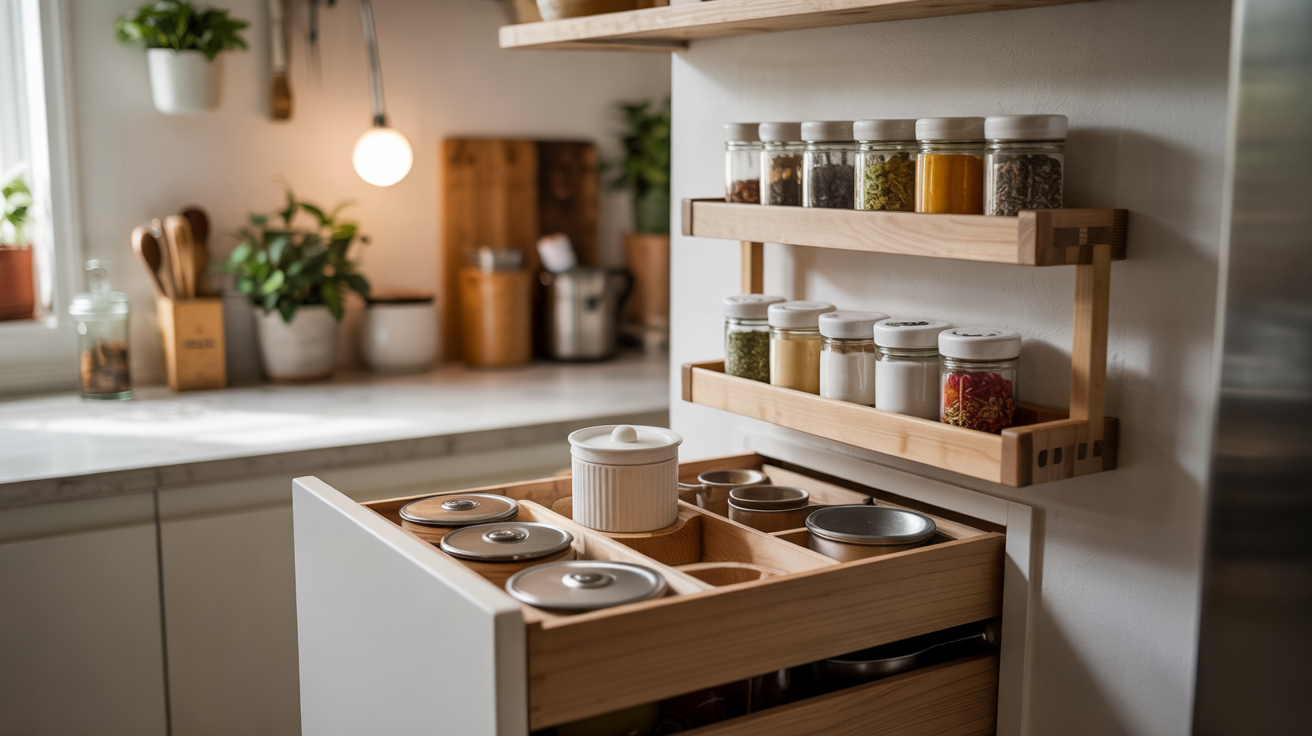
21. Store Spices on a Wall Rack
Spices scattered across cabinets are frustrating. A wall rack keeps them visible and easy to grab while cooking.
Ever wondered why recipes feel chaotic? Hunting for cumin doesn’t help. This fixes that.
22. Use Bins to Group Similar Items
Grouping items into bins keeps cabinets from becoming junk drawers. Snacks with snacks, baking with baking—it just makes sense.
I resisted this for way too long, and honestly, I regret it. Everything feels calmer now.
23. Add Shelf Risers
Shelf risers create extra layers in cabinets, which is perfect for plates and bowls. It stops stacking from getting out of control.
Simple, effective, and weirdly satisfying to look at. Sometimes the basics really are the best.
24. Store Cleaning Supplies Vertically
Under-sink areas are notorious mess zones. Using caddies or vertical storage keeps things contained and accessible.
I used to dread opening that cabinet—now it’s actually functional. Growth.
25. Reevaluate Regularly (Seriously)
Storage isn’t set-it-and-forget-it. As habits change, your kitchen should adapt too.
Every few months, I reassess what’s working and what’s just taking up space. It’s annoying but worth it, trust me.
Final Thoughts
Small kitchens can feel frustrating, but they’re also weirdly satisfying once you crack the storage code. You don’t need more space—you just need smarter systems that actually match how you live and cook. I’ve learned (the hard way) that tiny changes add up fast.
If there’s one takeaway here, it’s this: stop fighting your kitchen and start working with it. Be honest about what you use, what you don’t, and what drives you nuts daily. Once you do, even the smallest kitchen can feel calm, functional, and—dare I say—enjoyable.